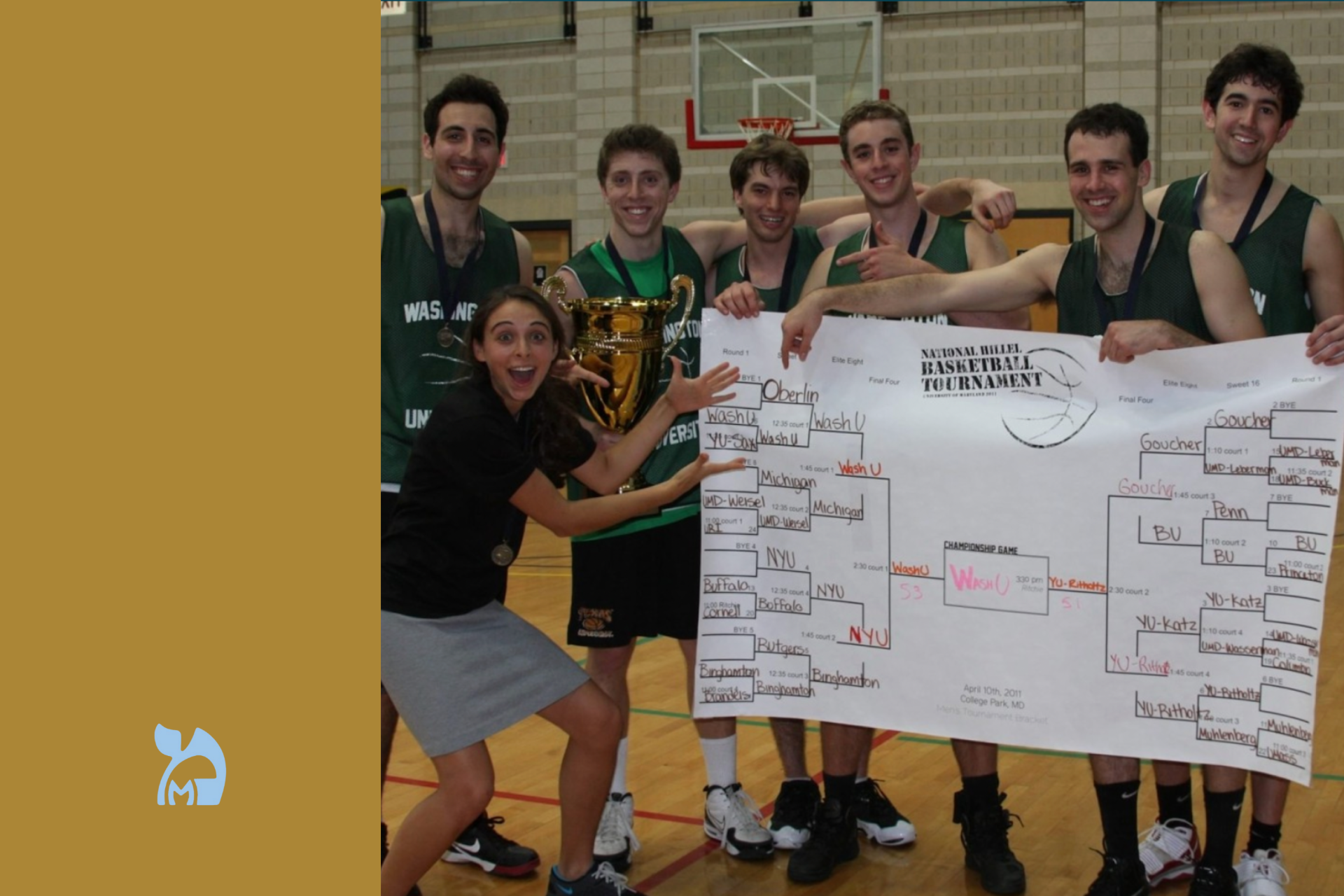

Entering its 15th year, the National Hillel Basketball Tournament (NHBT) looks very different from the idea Rachel Klausner first conceived in the fall of 2010. What began as a handful of Jewish students with an enthusiasm for basketball has grown into a nationwide event that now draws more than 50 schools and thousands of students each spring. Though only a part of NHBT for its inaugural tournament, Klausner’s idea would eventually expand far beyond what she could have ever imagined.
Klausner was originally part of planning a small three-on-three basketball tournament, “Dribbler on the Roof,” exclusively for students at the University of Maryland, College Park. During the tournament, a friend’s dad told her something that would stick with her for years to come.
“You should invite other schools to this,” he said.
After simmering with the idea for a couple of years, Klausner thought it was great; she finally decided to put her thoughts into action. It all started at the lounge of South Campus Commons 5 in 2010. Klausner, as the first tournament chair, specifically picked those whom she felt were doers; they included founding board members Eli Geller, Michael Shrager, and Shlomo Golshirazian, along with many others. The first student board, primarily made up of her close friends and people who trusted her enough to commit nearly a year to an untested idea, believed the tournament would be huge, even when the Hillel staff didn’t.

“They keep asking, ‘Are people gonna even sign up for this thing?’ But we just knew that it was going to be big,” said Klausner.
According to Klausner, the original NHBT had 32 teams: 24 men’s teams and eight women’s teams. However, it was by no means easy; 2010 was an early era for Google Forms, and they were nowhere near as easy to use as they are today. The original board had to request that the Hillel staff create a custom one for registering teams. They made their own rules from scratch, printed their own booklets, and mapped out the schedule on a maze of Post-it notes and markers, their legendary whiteboard becoming the centerpiece of the entire tournament.

“People were still on blackberries; they weren’t glued to their phones…just more down to help coordinate something in person,” said Klausner.
With no budget for hotels, the first NHBT board members, along with about 100 volunteers, were forced to host visiting teams in their own dorms and apartments.
“The power of this group was convincing people like, ‘Hey, we’re gonna have these teams, and we have this group coming from Binghamton. Could you host half their team? Then we’ll ask people down the hall to host the other half,” said Klausner.
For Klausner, a big reason for starting the tournament was the lack of connection between Hillels from different colleges at the time. She wanted a way to bring Jewish students together from across the country that Hillel just wasn’t providing. She felt basketball was the perfect way to do it, “For whatever reason, Jews love basketball. Our height doesn’t give us an advantage on the court, but we love it anyway,” she said.
Some Hillels can be very small on college campuses, so Klausner believed it was important to give them opportunities to meet others in the broader Jewish community.
“Building community is such a big part of the tournament…yes, basketball is critical, I love basketball, but the real craving, and the real reason we were doing this was that we wanted to bring kids together from across the country,” said Klausner.
After tons of hard work, the inaugural tournament in the spring of 2011 saw the underdog Washington University take home the first “Kiddush Cup” by beating Yeshiva 53-51 in triple overtime, according to a 2011 Jewish Herald-Voice article. Additionally, the University of Maryland women’s team beat NYU in a close match for the women’s championship.
The first tournament was a huge success, with over 2000 attendees touching the tournament floor over the weekend. Following this, Klausner graduated the next semester and was very worried about the tournament’s future. She knew it would continue for at least a few years, but was concerned that once all members of her original team graduated, the tournament would never happen again. She could not have been happier to be proven wrong.

Today, the tournament is growing larger and stronger than ever. Klausner is still surprised at the scale of some of the things today’s NHBT board can accomplish.
“We developed an app that close to 5,000 people use over the weekend. It manages 142 games, with every point, rebound, and stat recorded live. Working at that scale is something none of us had ever done before,” said Avi Baruch, executive technology director for NHBT 2026.
Klausner loves that some of the board members today don’t even know who she is (though that might change after this article) and that the tournament was still able to carry on despite her being uninvolved for the last 14 years. While her involvement only carried through the first tournament, her idea persisted. Every year, a new student board puts the tournament together. They may graduate, but there’s always new eager Freshmen to take their place.
“It’s so cool to see something continue without needing one person to be there year to year,” said Klausner.
The modern NHBT looks very different from the original, but the idea that sparked it has remained constant for fifteen years.
“The goal of this tournament should be to really just bring all Jews together from across the country to have a good time and to really show how amazing our generation of Jewish college students really is,” said Kira Wilbur, the executive game operations director for NHBT 2026.
Sound familiar? It should, because it’s the same belief Klausner had when she first imagined the tournament all those years ago.