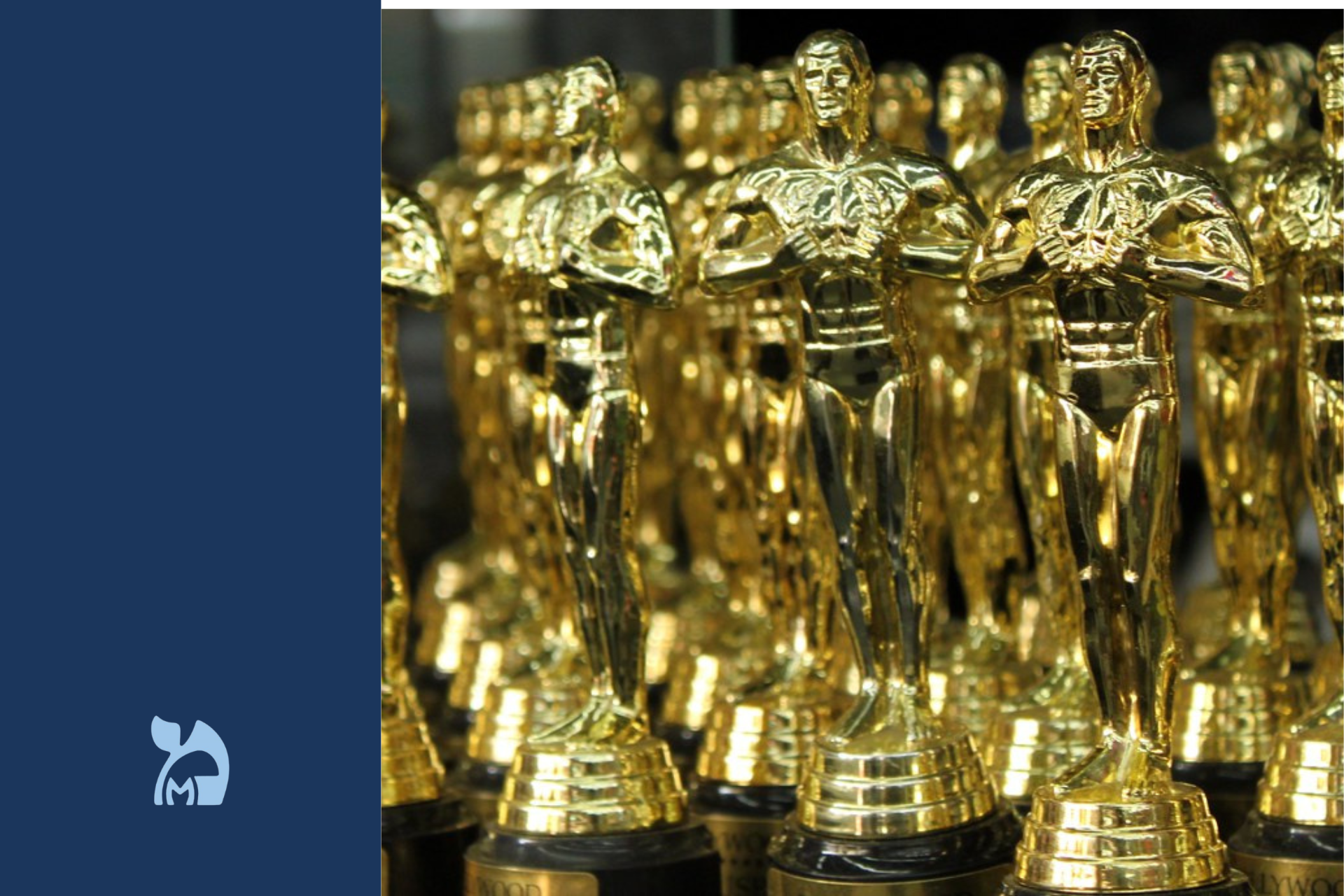
It’s that time of year again. The ballots are in, the campaigns are over and all that’s left is the ceremony itself. Here are ours, category by category, with full explanations for every pick.
Actor in a Leading Role — Michael B. Jordan, Sinners
This is genuinely one of the hardest calls on the ballot. Michael B. Jordan plays twin brothers in Sinners and does it so effortlessly that there were stretches of the film where we forgot we were not watching two different people. That is not a trick of editing or visual effects alone. That is acting: distinct physicality, distinct speech rhythms, deep emotional registers, layered on top of each other by one performer. Timothée Chalamet is equally extraordinary in Marty Supreme, commanding every frame with an intensity that feels almost dangerous. Either winner would be deserved. But Jordan’s technical achievement, combined with his raw emotional power, tips it for us.
Actor in a Supporting Role — Jacob Elordi, Frankenstein
Jacob Elordi has spent years quietly proving that there is far more to him than his looks. His work in Frankenstein is the definitive proof. The character does not speak for most of the movie. Not a single word. Elordi communicates everything through his body, his eyes, the tension in his jaw and the way he moves through spaces that were not built for someone with his stature. He accomplishes all of this under layers of prosthetics and makeup that would suffocate a lesser performance. The fact that we feel genuine grief for this creature, genuine longing, genuine confusion, is entirely due to Elordi.
Actress in a Leading Role — Jessie Buckley, Hamnet
Full disclosure: we had not seen this one coming. After Eternals, it felt like director Chloé Zhao might spend the next decade in filmmaker’s purgatory. Then, Hamnet. Quiet, devastating, precise. Jessie Buckley delivers what is, for our money, the strongest performance on this entire list. There is a scene where Buckley does almost nothing and it is still completely heartbreaking. She carries the weight of the film’s grief without ever letting it become a performance. This is the kind of work that defines a career.
Actress in a Supporting Role — Amy Madigan, Weapons
This might be the most contrarian pick on our entire ballot, and we are standing by it. Weapons is one of our favorite films in recent memory, a horror movie that understands that true dread comes not from what you see but from the feeling that something is wrong. Amy Madigan plays one of the greatest horror villains of the past several years. Her performance as Gladys can make you feel viscerally threatened, the kind of threatened you have not felt in a movie theater in a long time. She leans into the film’s stranger, more absurdist impulses without losing a single ounce of menace. That balance is almost impossible to achieve. Madigan makes it look effortless.
Animated Feature Film — KPop Demon Hunters
Zootopia 2 is an excellent film, justifying its existence scene by scene. But KPop Demon Hunters is something we have never encountered before. Vivid, maximalist animation is not a new trick, but the specific way this film deploys it, combined with songs that are absurdly catchy, great character development and positive messaging for kids, adds up to something singular.
Animated Short Film — The Girl Who Cried Pearls
Chris Lavis and Maciek Szczerbowski have one of the most distinctive visual signatures in contemporary animation. The Girl Who Cried Pearls showcases that gift at its fullest. This is fairy tale filmmaking in the truest sense with a visual language that exists entirely on its own unnatural terms. The emotional payoff is disproportionately large for its running time, which is the whole magic trick of the form.
Casting — Jennifer Venditti, Marty Supreme
This one is not close. The majority of the film’s extras were not professional actors. They were real New Yorkers, pulled into a recreation of their city’s past, and they sell that world completely. All of the grit and texture lives in the faces and bodies of people who were not running lines the night before. That is a casting director working at the absolute peak of her craft.
Cinematography — Autumn Durald Arkapaw, Sinners
Autumn Durald Arkapaw’s photography of the antebellum South is rich in a way that feels almost archaeological; you can feel the heat, the soil, the particular quality of light in that time and place. It is lush without being romantic. Beautiful without softening history. Dan Laustsen’s work on Frankenstein is also extraordinary, but Sinners edges it out for us.
Costume Design — Kate Hawley, Frankenstein
Every silhouette in Frankenstein is slightly too dramatic and slightly too severe. It is as if the clothes themselves are aware of the horror they are participating in. The costume design does the storytelling. Sinners, Hamnet and Marty Supreme all knock it out of the park in this category as well.
Directing — Ryan Coogler, Sinners
Give that man every award in the room. Ryan Coogler’s direction of Sinners is operating on a frequency that feels rare. He is doing everything at once, genre filmmaking, historical excavation, spiritual meditation and musical celebration. Not a single element collapses under the weight of the others. That is a director completely in control, completely confident, completely himself. Second place would be Safdie or Zhao.
Documentary Feature Film — Mr. Nobody against Putin
Mr. Nobody against Putin is the kind of film that reminds you why this medium exists, bearing witness and holding power accountable. In a field that includes strong contenders from Andrew Jarecki and Ryan White, this one stands out for the sheer weight of what it documents. There are some films you just watch. There are some films you feel obligated to see. This is the latter.
Documentary Short Film — Armed Only with a Camera: The Life and Death of Brent Renaud
Craig Renaud’s film about his brother Brent is both an act of mourning and a testament to the importance of documentary journalism. What makes it extraordinary as a short film is its restraint. It never lets grief tip into sentimentality and never loses sight of the larger argument.
Film Editing — Stephen Mirrione, F1
F1 is a film whose entire reason for existing lives in the editing suite. Formula 1 racing is, in real time, a sport of barely visible speed and technical minutiae. Making it cinematically thrilling, making an audience feel the stakes, the speed and the danger, is almost entirely an editorial achievement. Mirrione solves that problem brilliantly. I know Sinners is really good, but F1 relies on the editing to make the race scenes enticing. It edges past Marty Supreme for us.
International Feature Film — The Secret Agent, Brazil
The fact that The Secret Agent has gathered nominations across multiple categories in a ceremony dominated by English-language films is a remarkable achievement. For an international production to compete at this level in Best Picture speaks to a film operating at the absolute highest level of cinema. It deserves its flowers here.
Live Action Short Film — A Friend of Dorothy
“A Friend of Dorothy” is the old coded phrase used by gay men for decades when saying so plainly could cost you everything. Lee Knight and James Dean’s short film understands that history and wears it without making the film a history lesson. Great short filmmaking tries to illuminate a single moment so precisely that the rest of the story becomes visible in what remains unsaid.
Makeup and Hairstyling — Frankenstein
The detail in the creature’s design is extraordinary: every seam, every scar and every piece of stitched-together anatomy tells a story about this body’s journey. Mike Hill, Jordan Samuel and Cliona Furey built a character before Elordi could utter a single line of dialogue. Yes, Sinners has great effects for the vampires, but Frankenstein’s makeup is insanely good and has so much detail to it.
Original Score — Ludwig Göransson, Sinners
Ludwig Göransson’s score for Sinners creates a musical archaeology that mirrors what the film itself is doing with American history. It never feels like a pastiche or a reference. Jonny Greenwood in One Battle after Another is doing something equally fascinating, but the Sinners score is the one that stays with you. It is insanely good.
Original Song — “I Lied To You,” Sinners
“Golden” is the popular choice, and for understandable reasons. “I Lied To You,” written by Raphael Saadiq and Ludwig Göransson and sung so beautifully by Miles Canton, is the song that stops us cold every single time. It extends past the typical limitations of movie music.
Best Picture — Sinners
Come on. Like, there was any other answer. Sinners is the film that has dominated this entire awards conversation for a reason. It is one of the most complete, ambitious and fully realized American films in recent memory. Ryan Coogler set out to make something that simultaneously worked as a genre film, a historical film, a musical film, a spiritual film and a film about what it means to be Black in America. He made all of that into one movie.
Production Design — Frankenstein
Tamara Deverell and Shane Vieau built a world for Frankenstein that functions as a complete argument about the film’s themes. Every set communicates something about power and the grotesque ambitions of science. The film simultaneously operates within and dissects the Gothic tradition. The laboratory scenes in particular are extraordinary as spaces that feel both historical and deeply wrong, exactly as they should.
Sound — F1
The sound team on F1 had a near-impossible task: to make a sensory assault of a sport into a theatrical sound design. They solved it by being immersive without the exhaustion. The mix puts you inside the cockpit in a way that feels physiological rather than merely acoustic. You feel the G-forces in the sound.
Visual Effects — Avatar: Fire and Ash
Let’s be clear: Avatar: Fire and Ash is not a great movie. Ignoring what James Cameron’s VFX team has built would be intellectually dishonest. The world-building on a purely technical level is unmatched. There is a vivid sense of mass, weight, atmospheric depth, and biological specificity across every creature and environment. Credit where credit is due.
Adapted Screenplay — Will Tracy, Bugonia
Bugonia has been somewhat overlooked in the broader conversation, but it deserves real attention. Will Tracy’s script is wickedly funny and Emma Stone delivers one of her most textured performances in it. She could be a best supporting actress contender in the coming years if the Academy keeps paying attention. More people need to see this film.
Original Screenplay — Ryan Coogler, Sinners
Ryan Coogler wrote an original screenplay that contains multitudes: folk horror, love, family, cultural history and a meditation on loss. He did all of this without the seams ever showing. That is the mark of genuinely great screenwriting: not that you can identify every theme and technique, but that you cannot, because they have been completely absorbed into the lived experience of watching the film. He is the best working writer-director in American commercial cinema right now. The GOAT.