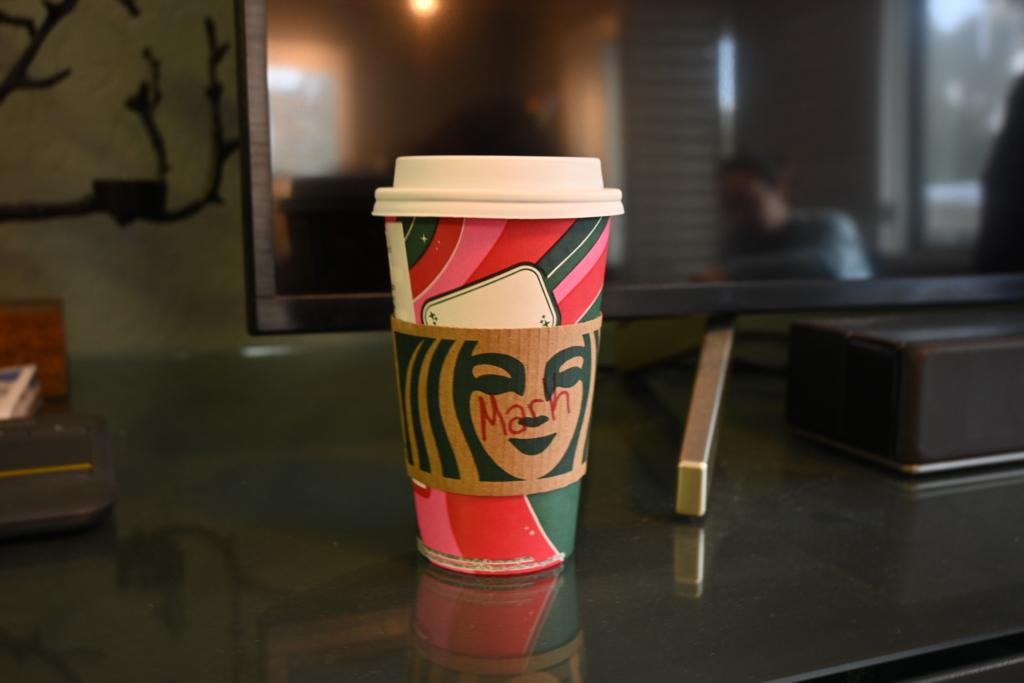
“Mark?” The barista says, placing the cup on the counter. I walk over and pick up my iced brown sugar oat milk shaken espresso. I have become so accustomed to using this fake name at Starbucks that I don’t even flinch when giving it to the barista. In fact, I’m beginning to identify more and more with this fictional espresso-loving character.
Everything about this Mark is indistinguishable. His religion, his sexuality, his family life, and his name are all so ordinary that they allow him to blend into the background of society. He has never had to worry about standing out. The name Shai is not exactly a mouthful, but Mark makes me feel comfortable in a way that Shai never could.
Mark is invisible and in that there is endless comfort.
The past two months have served as a reminder for Jews that we are still a persecuted minority. The fight against antisemitism is far from over. The recent spike in antisemitism has caused me to focus intensely on my Jewish identity and zero in on the things that make us different as a people.
One of the more lighthearted aspects I have been thinking about is the phenomenon of Starbucks names. I was first introduced to the concept of Starbucks names by my parents, Moshe and Risa, both of whom use different names at the counter. Upon asking my parents why they went by Mo and Reese, they explained that people don’t understand Jewish names, so it’s easier to give a fake name. And I get it. Although I have grown to love the name Shai, eventually I started to resent the quizzical looks that baristas would give me.
Mark was born out of this resentment.
Although the concept of Starbucks names is not a uniquely Jewish phenomenon, this process led me to take a deeper look into the practice of Jewish name-changing and its impact on Jewish history. In the years between the First and Second World Wars, American courthouses became flooded with name change requests by Jewish families implementing a new strategy for gaining employment. These families believed that their job opportunities would increase if they gave themselves less “foreign-sounding” family names. Thus Greenberg became Green, Rosenberg became Rosen and Smietanski became Smith.
Kirsten Fermaglich, author of “A Rosenberg by Any Other Name” explains that in 1932, Jewish family names made up 65% of New York City name change requests, which is vastly disproportionate to the Jewish population of the city at the time. For example, although the Jewish population in New York City at this time was roughly double that of Italians they changed their names at roughly six times the rate. This begs an interesting question; why, in a city that has been a historic melting pot of cultures for over a century, are Jews changing their name so disproportionately?
This desire did not come out of nowhere.
Antisemitism across America soared in the 1920s and 1930s, becoming institutionalized among employers and in higher education. According to a 1937 report, 89% of large New York companies declared that they “preferred Christians” as employees. A report from Fortune magazine notes that although in 1936, 50% of medical school applications were from Jews, only 17% of those accepted were Jewish. Names were a very popular way for admissions officers to screen potential candidates and filter out Jewish applicants. Although this information might seem like a relic of the past blatant discrimination against jews in the workplace persists even today. According to a survey conducted by Resumebuilder.com roughly 1 in 4 hiring managers admitted that they were less likely to move forward with Jewish applicants. I found this information very insightful as to the reasoning behind my predicament. Although on a much smaller scale, I feel like my name changing at Starbucks is at least partially related to the fear of rejection that has been instilled in Jewish people for generations.
Now, fearing rejection on the basis of being Jewish might seem more real than ever for Jews on college campuses across America. A study published by the Anti-Defamation League reported that since the October 7th attacks the number of Jewish students who feel comfortable with others knowing their Jewish Identity has dropped by nearly half. Although most universities require some sort of diversity, equity, and inclusion training, it rarely covers the Jewish community. The number of students who receive training on antisemitism is shockingly small. When college students are not educated on how to prevent themselves and others from committing acts of antisemitism, Jewish students are left to fend for themselves in institutions that are often not giving them the necessary support. Still, I do not think hiding is the answer.
One of the most poignant moments that influenced my conception of Jewish identity on this campus actually happened to someone else. The moment came in my theater communications class when my Jewish classmate Sarah was called on to speak. “Yes Zara,” my professor said despite weeks of her introducing herself as Sarah. Sarah’s visceral reaction to the mispronunciation seemed to go unnoticed by everyone but me, the only other Jewish member of the class. A couple of weeks later Sarah timidly explained that her name was not in fact “Zara” but Sarah, he apologized profusely. He then explained to us that we should never apologize or refrain from correcting someone’s pronunciation of our name. “Your name is your identity,” he said, “you should never have to apologize for preventing someone from being ignorant.”
If our universities balk at our requests for more education about antisemitism then we have no choice but to take action ourselves. If we never expose people to our diverse culture how do we ever expect them to become more educated and more aware? If we do not use our real names at Starbucks how can we ever expect the baristas to stop flinching when we give them our “clunky ethnic” names? If we do not accept ourselves how can we expect others to accept us?