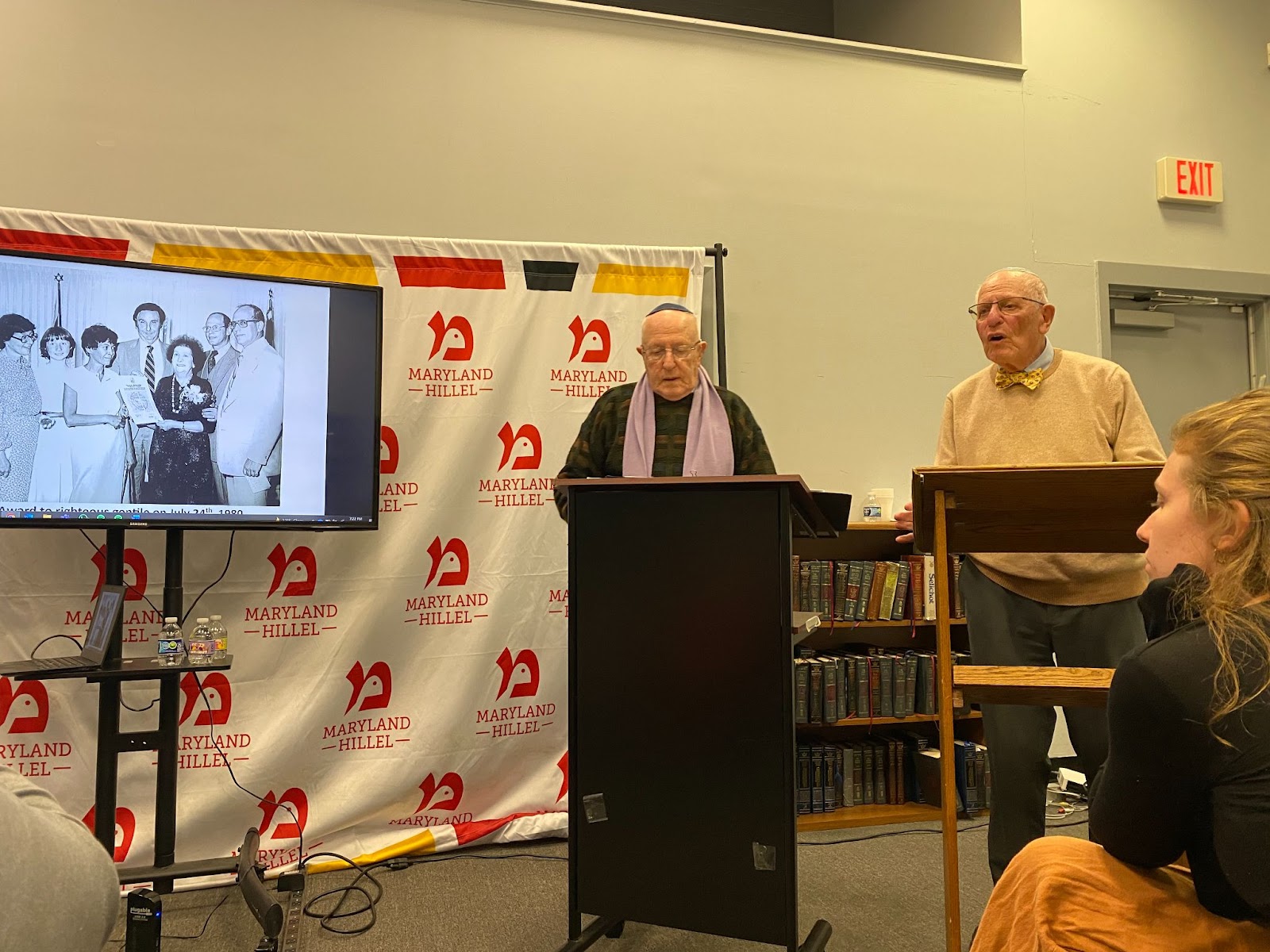
Holocaust survivors Henry and Bernard Schanzer delivered a testimony at Maryland Hillel Wednesday evening, sharing their experiences as children living through World War II and providing a message of perseverance and hope.
The testimony began around 6:30 p.m. and featured a presentation containing images of documents and photographs that defined the brothers’ journey to escape Nazi capture. The event was organized by the pair’s granddaughter, Elle Schanzer, who is currently a sophomore at the university.
“I try, in every different place I’ve been, to bring them and have them speak,” said Elle Schanzer.
The twin brothers, born in 1935, fled Belgium upon Hitler’s invasion in 1940. The family traveled to France in a small van, making it despite a German bombing campaign interrupting their route. The Schanzers lived in France for several years as conditions continued to worsen for the European Jewish population.
The Schanzer boys were relocated to a number of different locations across the country to avoid capture, including a Catholic orphanage. Eventually, the twins were forced into hiding at a small farm in 1942, with the help of a family of Catholics.
There, the Schanzers assumed a French identity, attending the local public school. Although their town of Saint-Pal-de-Mons did not fall under Nazi-occupied territory, the area was governed by leaders sympathetic to Hitler’s ideas.
The boys’ father, unable to join the rest of the family in hiding, was captured by police and sent to Auschwitz shortly afterward.
“85 years ago we were surrounded by…a pandemic of antisemitism,” said Henry Schanzer. “It was rapid. Virulent.”
Following the war, the surviving Schanzers emigrated to the United States. Henry went on to become a practicing attorney, while Bernard pursued medicine, becoming a doctor.
However, the brothers still live with the impacts of the fear and persecution they experienced during the Holocaust.
“We must remember that 6 million Jews, including 1.5 million children, were killed during the Shoah. Two-thirds of European Jewry. A Holocaust occurred,” said Henry Schanzer.
Much of the Schanzers’ testimony expressed gratitude for those who had helped them to survive, providing shelter and care during the war.
“We must follow the example of…the Righteous Among the Nations,” Henry Schanzer said, referring to individuals who aided those persecuted by the Nazi regime.
He continued, “We must have the same moral compass. We must look at evil and stand up to it. We have to have the courage of doing what is right.”
Along with their past, the Schanzers also shared their perspective on the future, in a world dealing with the aftermath of Oct. 7.
“We have to meet the challenges we face because of them,” said Henry Schanzer. “We have to be vigilant. We have to be active.”
“It’s important to learn from the history and the past,” Elle Schanzer said. “Never forget that this is how we survive.”