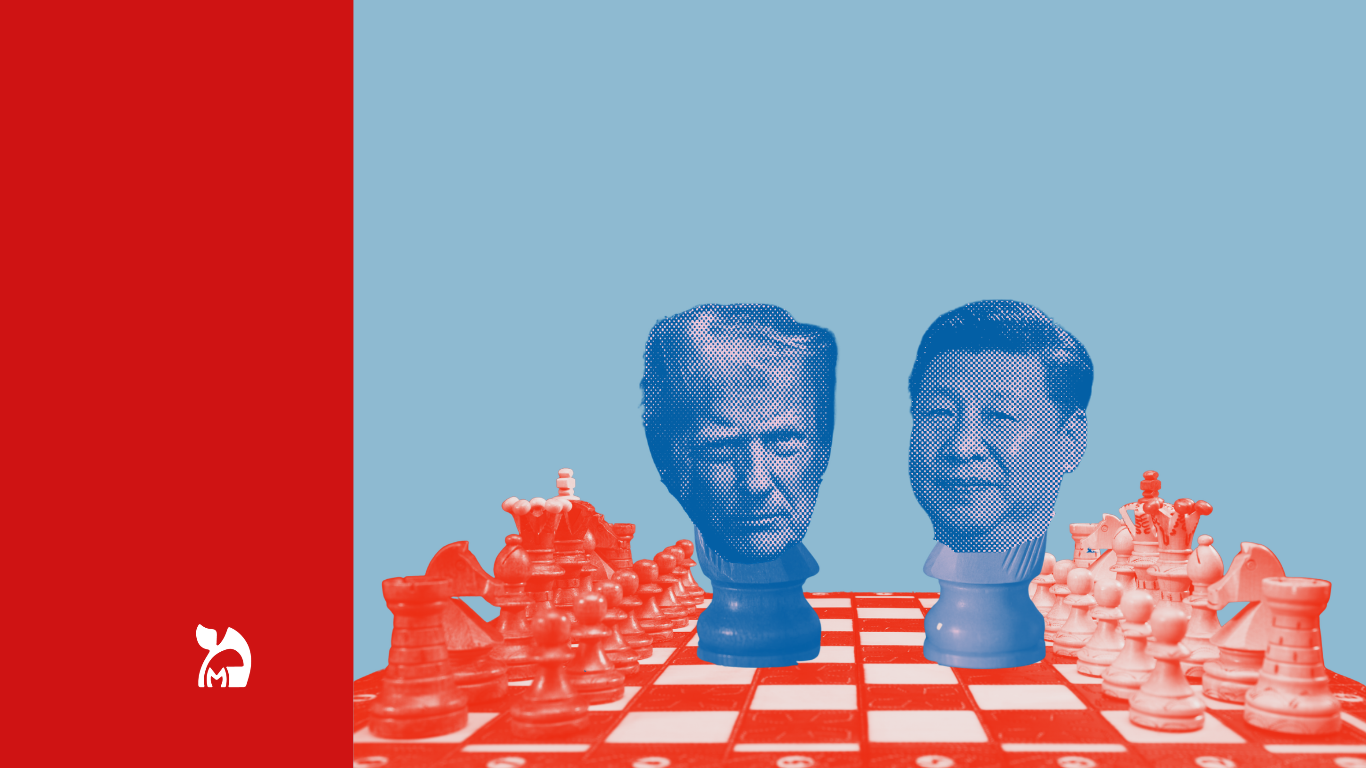
Seven years ago, Thomas Wright warned that progressives would be forced to choose between “waging the struggle against autocrats” and “deemphasizing military power.” Seven years later, they still haven’t made a choice, leaving the progressive foreign policy doctrine riddled with contradictions and promises it cannot keep.
The future of Democratic foreign policy is currently being shaped by disagreements between the center-left and progressive wings of the party.
Broadly, there is still agreement on the foundational values that should drive American foreign policy: democracy, human rights, rule of law, international cooperation, and opposition to authoritarian regimes.
However, the extent to which progressives are willing to invest in achieving these outcomes is insufficient. In this essay, I argue that the ideological underpinnings of the progressive foreign policy doctrine produce a classic contradiction between ends and means. Because of its rejection of geopolitically driven security problems as the core issue in international politics, the progressive camp has come to accept a multipolar world that threatens the moral ideals it claims to uphold. Its foreign policy doctrine tacitly (sometimes explicitly) endorses an overall posture in which America’s role on the global stage contracts, eroding our capacity to project both soft and hard power.
THE CENTRIST VS PROGRESSIVE DEBATE
Wright (2026) and Lind (2025) illustrate the key points of contention. Centrists prioritize restoring American national power, deepening alliances and partnerships with key allies, and strategic competition with illiberal powers such as China, Russia, and North Korea. This view places geopolitics at the center of the global threat arena, and views a militarily robust and technologically advanced United States as an indispensable actor in securing a prosperous and stable international order.
Progressives, on the other hand, prioritize transnational issues over geopolitical competition. They view climate change, global inequality, and AI as core threats that cannot be disregarded in favor of a hostile global environment of great power rivalry, identifying the center’s support for strategic competition between Beijing and the United States as a hawkish overextension of American capacities not in its core national interest.
The progressive view is shaped by a concern about what Lind calls the “overmilitarization of U.S. foreign policy” that stems from America’s foreign policy track record in the 21st century: destabilizing wars in Iraq, Afghanistan, Libya, now Iran, inaction on Israeli settlement construction in the West Bank that has destroyed the territorial contiguity necessary for a Palestinian state, as well as support for Netanyahu’s consistent waging of regional wars and Israeli conduct in Gaza, which they view as meeting the definition of genocide. Thus, as Lind summarizes it, the progressive camp assesses “the primary security problem in international politics is not rivalry among countries,” rather, it is the structural inequality they view as the root cause of global instability.
Still, these diagnostic disagreements between progressives and centrists do not preclude either camp from supporting NATO, Ukraine’s right to self-defense against Russian imperialism, America’s allies in the Indo-Pacific, and global cooperation on public health and standard of living issues through foreign aid programs like USAID. Centrists have also grown increasingly skeptical of U.S. military commitments to Israel. Rahm Emanuel has called for ending the roughly $3.3 billion a year in military aid Israel uses to buy American weapons, arguing it is wealthy enough to buy them like any other ally. Josh Shapiro has said Israel should lose access to U.S. weapons if it violates the terms of their sale, because “Israel should be treated as other nations are.” On China, however, the disagreement remains sharp, and the center-left holds a clear advantage.
PROGRESSIVES ARE WRONG ABOUT CHINA, AND IT’S MAKING THEIR PROPOSED POLICY WORSE
Progressives like Van Jackson prioritize “carrots over sticks” with Beijing; they think the U.S. should aim to prevent war rather than openly prepare for it through a hawkish China policy. Their concern is that a strong U.S. military posture in the Indo-Pacific (what they see as U.S. provocation) and trading restrictions with the PRC make war more likely.
Because of the progressive emphasis on transnational issues, they see cooperation with China as a moral necessity. On climate, there is no reason the two largest carbon dioxide emitters should be competing rather than cooperating. On AI, the two countries with the leading AI models should cooperate to prevent the emergence of a dangerous superintelligence. Bernie Sanders and Ro Khanna call for an agreement with Beijing to halt the development of dangerous AI systems, citing Cold War arms control as a model.
At their ideological core, many progressives, as Wright summarizes them, do not view the PRC as a revisionist power like Russia. Deterrence is seen as possible to achieve with existing American capabilities. Policies that actively strengthen the American footprint in the Indo-Pacific are therefore unnecessary and escalatory. While some progressives do recognize the broader threat China poses to open societies abroad, these policy prescriptions are simply not a highlighted feature of their foreign policy program because of an aversion to hawkishness.
This view is wrong. China is a revisionist power in the traditional sense, and therefore must be militarily deterred from seizing territory and resources through nationalistic projects of aggression.
The One-China principle held by the PRC is a nationalist and revisionist claim. It states there is only one China, Taiwan is an inalienable part of China, and the government in Beijing is the only legal government of all China. Beijing views reunification with Taiwan as unfinished business from its “century of humiliation,” despite the PRC never having governed the territory and 67 percent of its population identifying as primarily Taiwanese.
Beijing’s 2005 Anti-Secession Law commits Beijing to “non-peaceful means” if Taiwan secedes or peaceful unification is seen as no longer possible. Xi told the 2022 Party Congress the PRC “will never promise to renounce the use of force.” Last week, he stated “the tide of history cannot be stopped” and that unification with Taiwan is an “unwavering historical mission” of the CCP. Then-CIA Director Burns stated that Xi ordered the Chinese military to be militarily ready for a Taiwan invasion by 2027, although US officials assessed an invasion as unlikely before 2028.
You do not need to be an intelligence analyst to see that unification with Taiwan is an indispensable element of the CCP’s nationalist fantasies. Xi Jinping and his party are open about it. The same way a Greater Russia worldview is driving Putin’s invasion of Ukraine, a Greater China view drives Xi’s desire to capture Taiwan and subjugate the 23 million people who enjoy its thriving democracy.
If this does not prove China’s revisionist aims, add its aggression in the South China Sea to the PRC’s record. In 1947, Chinese mapmakers drew a U-shaped eleven-dash line enclosing about 90 percent of the South China Sea. It covered the Spratly, Pratas, and Paracel Islands, alongside the Macclesfield Bank and Scarborough Shoal. China claims its rights to these territories date back to ancient times.
Today’s nine-dash line overlaps the exclusive economic zones claimed by its neighbors, such as Vietnam, Philippines, Malaysia, Brunei, and Indonesia. In 2016, a tribunal constituted under the UN Convention on the Law of the Sea ruled that China had no legal basis to claim ‘historic rights’ to resources within the nine-dash line. It asserted that China violated Philippine sovereign rights by interfering with its fishing and petroleum exploration, and that its artificial island at Mischief Reef was illegally built inside the Philippines’ EEZ. However, Beijing rejected the ruling, calling it “worthless” this year, and claims most of the sea to this day. Since 2013, China has built at least seven artificial islands in the SCS, fully militarizing at least three of the islands.
China has carried out numerous acts of grey-zone warfare tactics against the Philippines and surrounding countries in the SCS, such as water cannon attacks, an armed boarding, and blockades. The most notable is the 2012 Scarborough standoff. A Philippine warship tried to arrest Chinese fishermen illegally poaching in the shoal’s lagoon, Chinese government ships blocked the arrest, and both sides kept ships there in a two-month standoff. US diplomats brokered a deal the Philippine government understood as a deal for both sides to withdraw their ships, but China kept its ships there after the Philippines pulled out, controlling the shoal ever since.
China’s illegal claims of “historic rights” to most of the South China Sea, construction and militarization of an artificial island inside the Philippines’ EEZ, and consistent use of grey-zone warfare tactics against its neighbors fits the same theme that defines its pursuit of Taiwanese unification: ambitions to revise the regional order according to its nationalistic vision.
Alongside military force, China also utilizes economic coercion to fulfill this vision. Japan is the most recent example. In November of 2025, PM Takaichi publicly stated that a Chinese blockade on Taiwan could constitute an existential threat to Japan, which could trigger 2015 security provisions passed by Abe that would allow Japan to engage in “collective self-defense.” In response to Takaichi’s comments, the PRC imposed export restrictions on dual-use goods and reportedly rare earths against Japanese companies, sanctions on an LDP lawmaker, as well as a seafood ban and travel warnings targeting Japan.
When South Korea allowed the U.S. to deploy a THAAD missile system to counter North Korean nuclear threats, Beijing retaliated with significant economic and diplomatic restrictions. It blocked South Korean entertainment and culture within China, targeted the South Korean conglomerate Lotte Group that provided the land where the THAAD was installed, and banned group tours to South Korea. Beijing’s retaliations were projected to cost South Korea $7.5 billion in 2017 alone, around 0.5% of South Korea’s GDP. Moon Jae-in adopted the Three Nos policy (no more THAAD, no participation in a U.S.-led regional missile defense effort, and no trilateral military alliance with the U.S. and Japan), leading Beijing to ease some of its restrictions.
When Lithuania let Taiwan open a representative office under its own name, China recalled its ambassador and choked off trade to Vilnius. In April of this year, China added seven European entities to its export control list for selling arms to Taiwan, its first ever use of that list against European companies. Back Taiwan and you will pay.
This coercion works because China refines 91 percent of the world’s rare earths and is the leading refiner of 19 of the 20 minerals the IEA considers “strategic minerals.” The European Union gets 98 percent of its permanent magnets from China. This is why centrists treat supply chain diversification as national security policy. Every refinery built in France, Australia, or the United States limits Beijing’s ability to economically coerce democracies across the world, especially America. The centrist program of rebuilding American manufacturing, securing critical minerals with the EU, Britain, Canada, and Japan, and backing it with a credible deterrence posture built on a robust American defense policy raises the price of Beijing’s aggressive foreign policy.
Cooperation with China on climate and AI is worth pursuing, but it cannot eat into the strength of this deterrence by cutting defense spending and downscaling America’s commitments to our allies like the restraint camp proposes.
Progressives and liberals agree on the same Asia: a free Taiwan, a denuclearized Korean Peninsula, and open South China Sea. Yet, the proposed policy program from progressive think tanks and politicians contradicts these goals. You cannot claim to agree with this vision for Asia, but also refuse to embrace a robust national defense program and iron-fisted deterrence of Beijing.
THE PROGRESSIVE DOCTRINE WEAKENS AMERICAN SOFT POWER
This contradiction runs beyond Asia. Both camps want a strong network of American soft power, with programs that keep global health clinics open, get vaccines to the poorest countries, and bring independent news to people living under censorship. But those programs only work inside a world order that American hard power keeps stable. The progressive doctrine cuts the power that protects all of these things. It accepts a multipolar world in which America’s global network of alliances and commitments contracts, leaving Moscow and Beijing to fill the gaps.
Elected progressives do tend to recognize the tremendous positives produced by American power. Both Michigan’s Senator-elect Abdul El-Sayed, a progressive, and Pete Buttigieg, a center-left politician, have criticized the Trump Administration’s dismantling of the U.S. Agency for International Development (USAID). Both Rep. Alexandria Ocasio-Cortez and Chuck Schumer have consistently voted to support U.S. assistance to Ukraine and sanctions on the Kremlin.
USAID-supported programs have prevented more than 91 million deaths between 2001 and 2021, with roughly 30 million of them being children. PEPFAR is credited with saving 26 million lives and allowing 7.8 million babies to be born without HIV. Programs like Radio Free Europe and Radio Free Asia provide accurate news and information to nearly 50 million people in closed societies across the globe. All of these initiatives are under attack by the Trump Administration, either being fully shut down by terminating grants, or severely slowed by executive pressure. For three reasons, we cannot separate our hard power from these soft power programs.
First, when spheres of influence begin to emerge as American hard power retracts, cooperation on international issues gets taken hostage by great-power rivalry. Look at China’s rejection of climate talks with the U.S. in 2022 due to Pelosi’s visit to Taiwan; or Russia expelling USAID in 2012 for supposed political influence. Inside spheres of influence, diplomacy, humanitarian efforts, and even peaceful conflict-prevention initiatives get reinterpreted as rivalry and undue interference.
Second, as geopolitical security issues become more potent, insecurity crowds out spending on humanitarian efforts. The United Kingdom’s prime minister is cutting aid from 0.5% to 0.3% of national income to fund defense, leaving the UK at its lowest share of national income since 1999. The Pentagon announced it planned to withdraw 5,000 U.S. service members from Germany. At the same time, Berlin raised its military spending while cutting its humanitarian aid in half. Switzerland, too, is slashing its funding for international humanitarian agencies to offset higher military spending. Official development assistance in the OECD’s standard measure fell 23.1 percent in 2025, and funding reaching the world’s poorest in places like sub-Saharan Africa fell by more than a fifth. It was the first year on record that the five largest donors all cut aid at once.
The trend is clear: As the U.S. commitment to European security weakens, our allies must make up for it by slashing programs that save people’s lives in order to cover their losses in national security. Every dollar Europe spends replacing American deterrence is a dollar that no longer reaches a clinic in Malawi or a refugee camp in South Sudan.
Third, most obviously, soft deterrence leads to war, war leads to humanitarian disasters, and humanitarian disasters create the conditions for long-term suffering. The Iran War may push 45 million people into acute hunger in 53 countries because of the economic impact of the closure of the Strait of Hormuz, a geopolitical crisis the U.S. irresponsibly manufactured. The Syrian Civil War saw the deaths of nearly 600,000 people, a destabilizing refugee crisis, and millions injured, displaced, and oppressed. Syria became an arena for great-power competition between Russia and the United States.
America ultimately failed to rein in Bashar al-Assad’s worst excesses. Obama claimed the regime’s use of chemical weapons would be a “red line” that may force U.S. intervention, which was crossed when Assad killed 1,400+ Syrian civilians with sarin gas. But the U.S. did not intervene due to domestic political constraints and the British Parliament’s refusal to join the military action, allowing Russia to enter in 2015 and save Assad’s regime.
The attempt to decouple hard power from soft power is futile. Nothing in the record suggests it works. The post–World War II international rules-based order, which the U.S. has admittedly often failed to uphold by standing aside and by starting wars of our own, was ultimately established and asserted through a forceful military defeat of fascism.
This mistake comes from the same source as the progressive misreading of China: ranking transnational problems above geopolitical ones. But climate change, artificial intelligence and corruption can only be addressed in a world where the major powers are not coercing one another. Geopolitics first and foremost decides whether cooperation on these problems is possible at all.
THE IRAN WAR AS A COUNTERARGUMENT TO AMERICAN HEGEMONY
The obvious case against American hegemony is pointing to failed interventions like Trump’s war in Iran. The progressive camp will look at Iran and say preponderant American power creates harmful wars of choice. This is a valid criticism.
America’s war in Iran has led to IRGC hardliners consolidating power around Mojtaba Khamenei. A CSIS analysis estimates the war has depleted roughly two-thirds of the U.S.’ stockpile of Patriot interceptors, creating a “near- to medium-term risk” for America’s military readiness to fight a war against China in the Pacific. The operation failed to destroy the Iranian nuclear program, with the regime believed to retain most of its 440 kg of uranium enriched up to 60 percent, and inspired a newfound political will among the regime to build a nuclear weapon. A U.S. strike on an elementary school in Minab on the war’s first day killed more than 150 people. American allies in the Gulf are now questioning whether their security arrangements with the U.S. are enough. Saudi Arabia has reportedly floated a regional non-aggression pact that would include the Islamic Republic, which could significantly curb the U.S.’s influence in the Persian Gulf. A war meant to project American power has so far failed at its core operational goals, and may push our closest partners toward a separate peace with the regime we are fighting.
But this failure is not evidence against the center-left vision for American hegemony. The pro-American hegemony argument is that Iran demonstrates how the U.S. should be investing in deterrence against Beijing and in European security, not a costly and legally suspect war that leaves America weaker in the Middle East and Pacific. This is why the center-left flank of the Democratic Party has consistently opposed it. Progressives correctly read American failures and oversteps in Iraq, Afghanistan, and Iran as disasters. But concluding that American power itself is the problem and therefore supporting its contraction is a logical error. It is the misuse of power that should be avoided, not power itself.
The center-left should understand, however, that the risk of Presidents unilaterally starting costly wars of choice is higher when American hard power is strong, and support increased Congressional oversight of the executive to counterbalance this.
However, congressional oversight must not produce paralysis on foreign intervention. Some of the best uses of American power came without authorization. In 2014, ISIS trapped tens of thousands of Yazidis on Mount Sinjar, and Obama conducted targeted airstrikes and provided emergency air relief to besieged civilians without congressional authorization. Alongside Kurdish fighters, it helped break the siege and saved thousands of innocent lives. In 1999, Bill Clinton in cooperation with NATO authorized a bombing campaign against Serbia to stop the ethnic cleansing of Kosovar Albanians without the House’s approval.
Congressional oversight should make presidents justify force, but not stop them from preventing an atrocity while the House debates. Yet some in the progressive camp Wright (2026) describes only support wars in self-defense that are authorized by Congress. Under this rule, the Yazidis on Sinjar and Kosovars in Pristina would not have been saved. American power when used well can be an enormous force for good, and the progressive tendency to unconditionally oppose foreign interventions that are not purely defensive risks sacrificing our commitment to atrocity prevention.
CONCLUSION
Ben Rhodes is incorrect that the U.S. needs to approach the world as “something other than a hegemon.” Hegemony comes from the ancient Greek word “hēgemonia,” meaning “authority” or “leadership.” Strong leadership is not problematic when it is used to do good. America as the global hegemon has overseen the creation of programs that save millions of lives from disease. It protects our democratic allies from authoritarian wars of conquest through strong military deterrence. Despite the Trump administration’s $3 billion cuts across federal research and science agencies, the U.S. remains one of the world’s two largest contributors to scientific research and development.
The policy prescriptions that emerge from this cannot be to shrink our defense spending, terminate mutual defense agreements in countries like the Philippines, or withdraw troops in crucial flashpoints like South Korea, as groups like the Quincy Institute propose. America’s military, logistical, and technological bandwidth must be preserved as a beacon of stability for countries to look toward and integrate into. Through this process, the U.S. can leverage its trusted and credible power to support the ideals of democracy, freedom, rule of law, and human rights. This vision is at the core of a center-left and internationalist foreign policy — the same one that helped rebuild Europe out of its ashes post-WWII and set the norms of cooperation that the institutions progressives defend still run on. Progressives can defend those institutions or cut the muscle behind them, but they cannot do both.