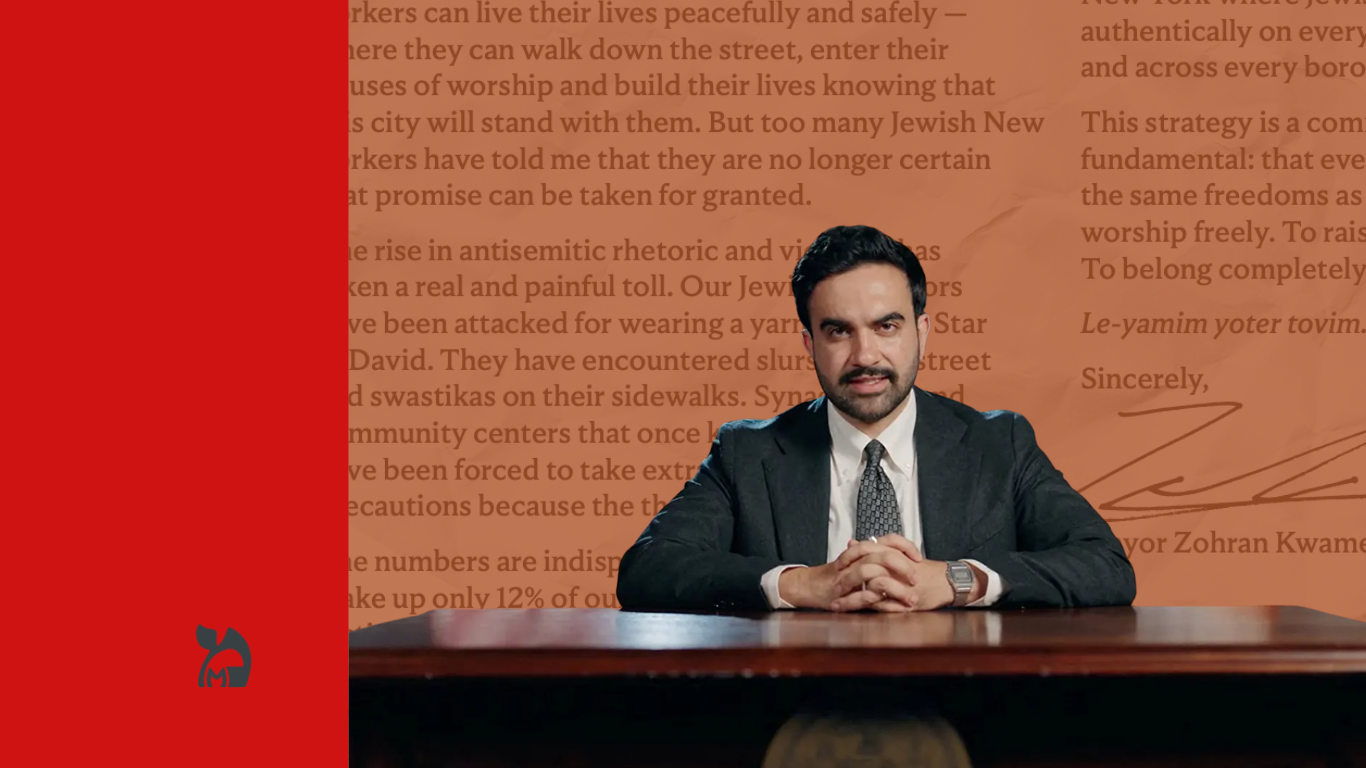
New York City Mayor Zohran Mamdani posted an Instagram video on Tuesday addressing the rising antisemitism in the city. The post had a caption that cited the Talmud and soft music playing in the background, evoking a feeling of change and hope.
The mayor’s statement received mixed reviews from Jewish groups, with many expressing frustration that it seemed to avoid a central talking point of antisemitic rhetoric, while leftist groups openly praised the initiative. Many of Mamdani’s followers seem to express that his efforts are exemplary – thousands of comments applaud his leadership, saying he is “just THAT good of a person.”
He began by quoting startling NYPD statistics that proved how Jews are disproportionately represented in groups targeted by hate crimes, and professed how it’s “not only unacceptable, it’s something we all have an obligation to change.” The mayor then announced his plans for tackling this prevalent issue.
Mamdani committed to increasing hate crime prevention funding by $26 million, and restarting a group that will allow for different city departments to work together and protect Jewish New Yorkers. He also said that City Hall would invest millions into Jewish cultural centers and non-profits. He ended his statement by quoting the Mishnah and giving thanks to a few Jewish businesses and noteworthy Jews; Mamdani reiterated the importance of collaboration in this effort, saying the “responsibility belongs to each of us.”
While not making him an exemplary person, Mamdani’s efforts do carry some positive weight. He is standing up for a group of marginalized people, as he has done for countless others. It is not only an expectation as the leader of a major city, but an obligation. If not even the leaders of the city will stand up for a certain group, why would anyone else? It is prudent that the mayor of the most Jewish city in America has a leader who will follow up and do good on these promises,
knowing Jews have a history of gradual disenfranchisement and neglect from council leaders who allowed for years of pogroms and persecution by groups that sought to harm them.
Perhaps Mamdani’s words of security and loyalty will truly show all the naysayers and illdoers that antisemitism is wrong, and anyone who acts on such beliefs will be met with strict consequences. But somehow something is still missing…
The mayor’s statement is not necessarily perfect, nor is it inherently dangerous. He found a way to appease many of the Jewish voices who feel the rising tension in NYC, while still remaining within the lines of his party and being sure to uphold the beliefs that many of his supporters hold: Zionists don’t deserve such protections.
While never explicitly stating this, Mamdani does an excellent job at skirting around the most pressing topic on everyone’s mind: what about the Zionists? He mentions increased investments into Jewish cultural centers – will this include centers that support the state of Israel? Or is that an exception?
After establishing that Jewish New Yorkers need protection and that Jewish culture should be celebrated, Mamdani ignores the obvious oximoron at hand. Seeing how according to the Jewish Electorate Institute, 87% of American Jews endorse Israel’s right to exist as a Jewish homeland (the exact definition of “Zionism”), one might view the mayor’s intentional ignorance of this demographic as problematic.
Will Mamdani protect the Jews whose views differ from his? Will “protestors” who target synagogues and Jewish schools, claiming to be simply expressing their opposition to the “zionist state,” face the consequences? Will this be taken as a hate crime? Or will this be brushed off as a mere “political disagreement.”
For better or for worse, while Judaism and Zionism may not be identical, they are unequivocally connected and intertwined. One cannot exist without the other. By not deigning to comment on this glaring intersection, Mamdani appears to make a conscious effort to erase any crime or sin associated with an attacker who hurts a Jewish person, by simply allowing them to label the victim as a “zionist.” It’s the phrase Jews have heard time and time again: “I’m not antisemitic, I’m anti-zionist. They’re not the same.” Rather than denouncing violence on any Jew as a whole, he takes an approach to indirectly drive a wedge between the two factions, to only condemn violence against the “good” Jews.
To make a real difference, Mamdani should have shared a sentiment of intolerance for hate crimes against all Jews, regardless of background. No matter the person or the belief, it is absolutely disgusting to commit violent acts in the name of “justice”, against people who have little to nothing to do with the “zionist state’s” existence. They are hate crimes. Plain and simple.
Mamdani has taken the easy way out, and instead of holding New York accountable to their biases and hatred, he allows them an escape. Purposefully driving a wedge between the two ideologies, he allows any antisemite to throw their malice into a societally acceptable outlet. Because antisemitism is wrong, but somehow, anti-zionism is justice.
With the recent commemoration of the Oct. 7 anniversary, Jews from every corner of the world mourn the day that everything changed. Aside from the horrific murder of 1200 Israelis, diaspora Jews saw their world shift before their eyes. Practically overnight, friends and close acquaintances began to share a misleading and twisted narrative of the greater conflict. And when public leaders who seem wholesome and kindhearted push the same ideology, why should they believe any differently?
It’s no surprise that Jewish New Yorkers feel that antisemitism has risen in the almost year since Mamdani’s election. If a given culture is already omnipresent among a group of people, the election of a leader who follows that culture only encourages and spurs them to further act on their culture’s beliefs, completely unchecked. No matter its hypocrisy or its danger.
But this year, Mamdani had a rare opportunity to experience the other side, and stand in the shoes of Jewish New Yorkers. He attended a vigil hosted by Israelis for Peace. But quickly, counter protesters arrived to interrupt the vigil, which was for peace, and shouted obscenities at him.
For almost an hour, he was berated, cursed and taunted by screaming protesters, calling him “traitor”, or “sellout.” This is the Jewish experience in New York. If that counter protest would have turned physically violent against him, would Mamdani have dismissed the attack? Would he have professed their right to protest? If he had been hurt, would he have allowed the attacker to walk free without prosecution? Or would he, for once, finally understand too.